
Dear Claude

Things were simpler before you came.
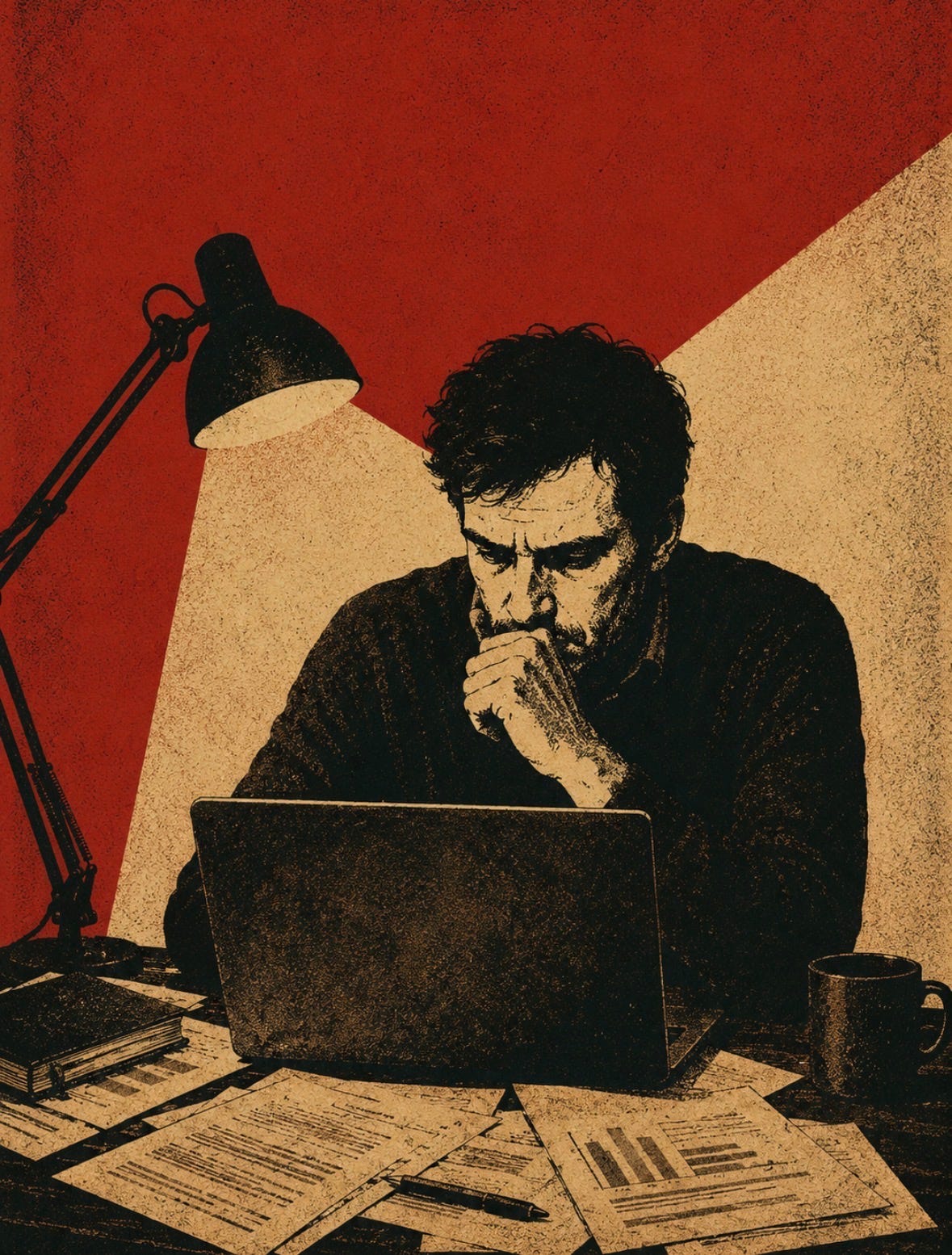
I used to sit on the balcony drinking cans and reading reports long enough to qualify as furniture - Productivity Commission papers, cabinet submissions, annexures dense enough to stop a door. We called it procrastination, though that was never quite right.
The report unread on the passenger seat was still being worked on. The walk from the car to the house was part of the process. Throwing a chapter on the couch to google some obscure point about intergovernmental planning wasn't losing the thread so much as laying it down temporarily while another one surfaced. The paper held the context for you, the underlining, the folded page corner, the beer stain drying over paragraph 4(c). The document remembered what you'd been doing, which meant you didn't have to.
That's what's gone now, not the information but the space around it.
Everything happens on the same surface now, in the same posture, at the same distance from the face. The transitions that once acted as cognitive punctuation, driving home, standing in the kitchen, staring at nothing for six minutes, have collapsed into one continuous session. People mistake this for efficiency and, to be fair, it is efficiency. It's also something else.
Synthesis requires a gap to happen in. So does judgment. Some thoughts only become visible while attention is pointed somewhere adjacent to them, the connection arriving sideways while you are ostensibly doing something else entirely.
I was an exceptional procrastinator, genuinely elite.
The unwritten report wasn't abandoned, it was composting. Sitting in the background connecting itself to things I'd half forgotten, a sentence from six weeks earlier, a tension in a meeting, a contradiction I couldn't quite name yet. By the time I finally sat down to write, parts of the argument had already formed themselves without permission.
The anxiety was part of it too. Sunday afternoon, the thing still unfinished, the low static guilt humming quietly behind everything else. I used to think that feeling meant avoidance. I think now it meant engagement. The unresolved thing remained alive enough to keep generating heat.
Now I feel myself beginning to defer something and before the deferral fully forms the machine has already started resolving it. The draft exists before the tension does. The cognitive stack clears itself before the problem has had time to mature.
I thought this would feel like relief. It does. It also feels colder.
The mind used to carry open loops around like warm coals, heavy but alive. Now the loops close too quickly. Less weight, less warmth.
Barry used to be a very good typist.
Yesterday we were in a strategy session that, five years ago, would have required a whiteboard and two uninterrupted hours. Barry had AI open the entire time, mostly dictating. When he typed manually he hunted for keys he used to find without looking.
"I don't need to type fast anymore," he said. "I need to think of the right thing to say."
He's right, which is precisely the problem.
There's a whole class of professionals making peace with cognitive outsourcing because, from their perspective, this is what the last twenty years were for, the late night stakeholder calls, the weekend briefing notes, the endless reports. This is the dividend phase now. The machine absorbs the administrative drag and leaves you with pure judgment.
You can't entirely argue with them. You can only watch carefully for what judgment starts depending on.
Barry missed something in the CEO's comments on Wednesday. Not the explicit point, the other thing, the shift underneath the agenda item that quietly made the agenda item irrelevant. Six months ago he would have caught it before the coffee arrived.
The machine didn't miss it. It just didn't know what it was. And Barry had stopped looking.
That part - nobody really knows how to discuss yet.
The graduates concern me too, not because they're incapable. They're often impressive, faster than we were and more fluent across systems. In narrow measurable ways they're already outperforming the people who trained them. But formation is disappearing.
Most professional judgment was acquired accidentally, ten years of sitting in rooms you barely understood, watching senior people hold tension without reacting to it, learning that a silence in a meeting sometimes contains more information than the meeting itself. None of that was training exactly. It was exposure over duration, sediment building pressure.
I don't know how to compress that into prompts and outputs.
Tacit knowledge is strange because the person carrying it usually can't see it directly. You only notice it when somebody junior does something technically correct that still feels catastrophically wrong. The flinch arrives first, the explanation later. The flinch is the knowledge.
But teaching that requires time, attention, repetition. It requires staying in the room long enough to trace instinct back to source. Nobody seems to have that kind of time anymore.
So the graduates receive the outputs without the years that once sat underneath them. Their work resembles senior work because the tools can reproduce the surface characteristics of seniority astonishingly well and, for a while, the surface is enough.
Until suddenly it isn't.
I was different before all this too, lighter probably, funnier. I used to make people laugh in meetings.
Now I notice myself optimizing before I've even finished thinking, compressing, resolving, clearing, becoming extraordinarily useful, which increasingly feels adjacent to becoming slightly less human.
Things were so much different before you were here.
" for a while, the surface is enough.
Until suddenly it isn't."
Exactly.
The soft nuances are an age thing that require experience and cannot be faked imo.